
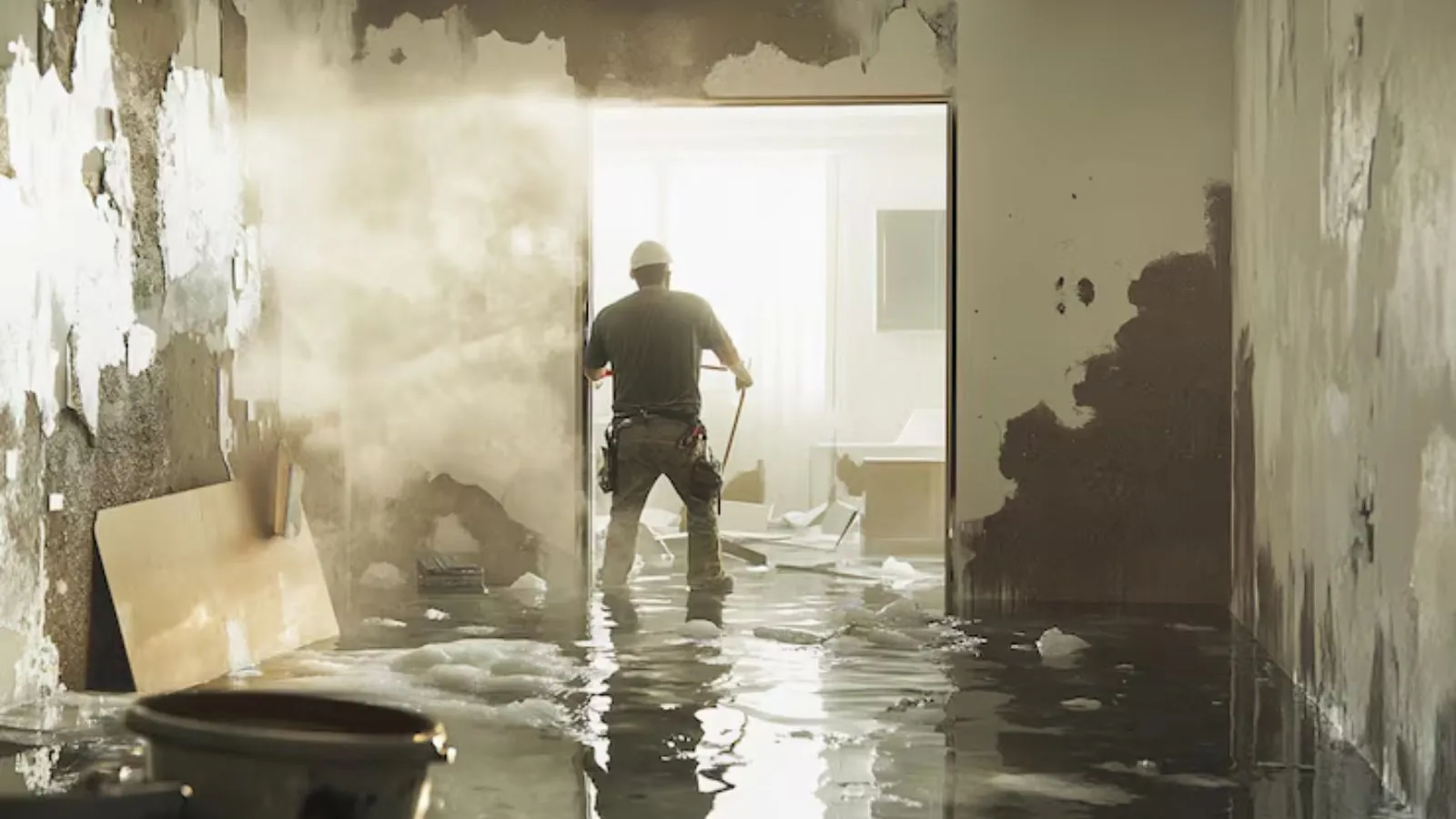
A wall that looks fine can be soaked inside. Wall and drywall water damage in Port Washington often begins with a pipe, a roof leak or a rising floor flood, and the water travels through the cavity behind the paint. Repair means finding where the moisture went, drying what can recover and cutting out what cannot.
Drywall is paper-faced gypsum, and it behaves very differently from plaster, wood paneling or wallpapered walls. Drying the board in place or cutting it out turns on the water category, the hours it stayed soaked and what sits inside the cavity. This page covers the options, the tools and the trade-offs.
Hidden damage behind the paint
Water rarely stays where it entered. It wicks up the drywall paper, runs down inside the cavity, and soaks the bottom plate, the insulation and the back of the baseboard. By the time a stain or bubble shows on the face, the cavity has often been wet for days.
So readings come first and the saw comes later. They show the wet zone, which is often larger than the visible stain. Pinhead probes and the camera also help confirm where a plumbing leak sits so the right section is opened.
Signs the wall is holding water
Look for these before you assume the wall is dry.
- Paint bubbles, peels or shows a brown ring that grows after it dries.
- Baseboards swell, gap from the wall or show a dark line at the bottom.
- The drywall feels soft, crumbles at a screw or sags between studs.
- Wallpaper seams lift or the pattern shifts and stains.
- A musty smell comes from a room with no visible leak.
- A thermal camera shows cool patches on the wall face.
Questions about your situation? Call the 24/7 line and describe what you see.
☎ Call (516) 845-9582Dry in place, drill or cut
There are three ways to treat a wet wall, each with limits.
| Method | Where it fits | Limit |
|---|---|---|
| Dry in place with air flow | Clean water, caught early, paint intact | Slow if insulation is wet |
| Drill weep holes or ports | Closed cavities behind trim or tile | Holes need patching, results vary |
| Flood cut | Water above the base, wet insulation | Cut height set by the wet line |
| Remove full sheets | Category 3 water or board that crumbled | Highest rebuild scope |
How a flood cut works
A flood cut is a straight horizontal cut a few inches above the wet line.
Find the wet line
Moisture meters mark how high the water traveled up the drywall.
Remove the baseboard
Trim comes off carefully so it can be reused where it is dry.
Cut and open the cavity
The board is cut above the wet line and the lower piece is removed, exposing the insulation and framing.
Pull wet insulation
Fiberglass and similar batts hold water and are usually discarded.
Dry the framing
Studs and bottom plates stay under drying gear until their numbers match a dry wall elsewhere in the house.
Plaster, paneling and wallpaper
Older homes and special finishes need different handling.
Plaster
Plaster over lath can often be dried because it is thick and mineral. Loose or crumbling sections may still have to come off.
Wood paneling
Solid panels can sometimes be dried and refinished, but thin veneer paneling tends to swell.
Wallpaper
Paper over wet drywall usually bubbles and is not worth trying to save. It is often removed so the board can dry.
Painted drywall
Latex paint sheds water for a while, so the face may look sound while the back of the board is wet.
Finish work after drying
Once the framing reads dry, new drywall is hung, taped, mudded and sanded, then primed and painted. Matching texture and paint sheen takes care, and the paint on a whole wall often gets redone so patches do not show. Baseboard is reset or replaced.
Whether a rebuild needs a permit depends on how much gets replaced. The Town of North Hempstead answers that for unincorporated areas, while a village such as Manorhaven runs its own office. A small patch may not need a permit, while larger structural or electrical work may.
What drives the price
Wall repair varies widely, and these are the actual factors:
- The water category, because category 3 water means full removal of porous material.
- The linear footage of wall affected and the height of the wet line.
- The materials involved, from standard drywall to plaster or paneling.
- Days of drying and the machines tied up in the cavity.
- The rebuild scope, including insulation, texture, paint and trim.
- The 24/7 line can walk you through scope and price ahead of any demolition.
Insurance and Port Washington homes
A sudden pipe failure inside a wall is often covered, while a slow weep behind the board often is not. Photograph the wall and the failed part before cleanup, then ask your insurer how your policy reads. Water that entered from outside as flood needs its own flood policy.
Freezing weather can split a supply line behind an exterior wall, and the stain may appear only once things warm up. See ceiling water damage repair if the leak came from above, and structural drying for how framing is dried. Homes in Roslyn Heights use the same process.
Frequently asked questions
Can wet drywall be dried instead of replaced?
Sometimes. Clean water caught early, with paint intact and dry insulation, can often be dried in place. Soft or crumbling board is replaced.
What is a flood cut?
It is a horizontal cut a few inches above the wet line that lets crews remove the lower drywall and wet insulation and dry the studs.
Do weep holes really work?
They can help air reach a closed cavity, but they are not right for every wall. A meter shows whether the cavity actually dries.
How do you find damage behind a wall?
By scanning with meters and a thermal camera, then cutting a small inspection hole if the numbers stay high.
Do I need a permit to rebuild the wall?
It depends on the scope. Unincorporated streets use the Town office, and village streets use village hall.
What if mold shows on the wall?
Mold needs moisture, so drying comes first. Staining or a musty cavity points to mold remediation, where New York requires a separate assessment.
Ready to talk it through? Call the 24/7 line.
☎ Call (516) 845-9582