
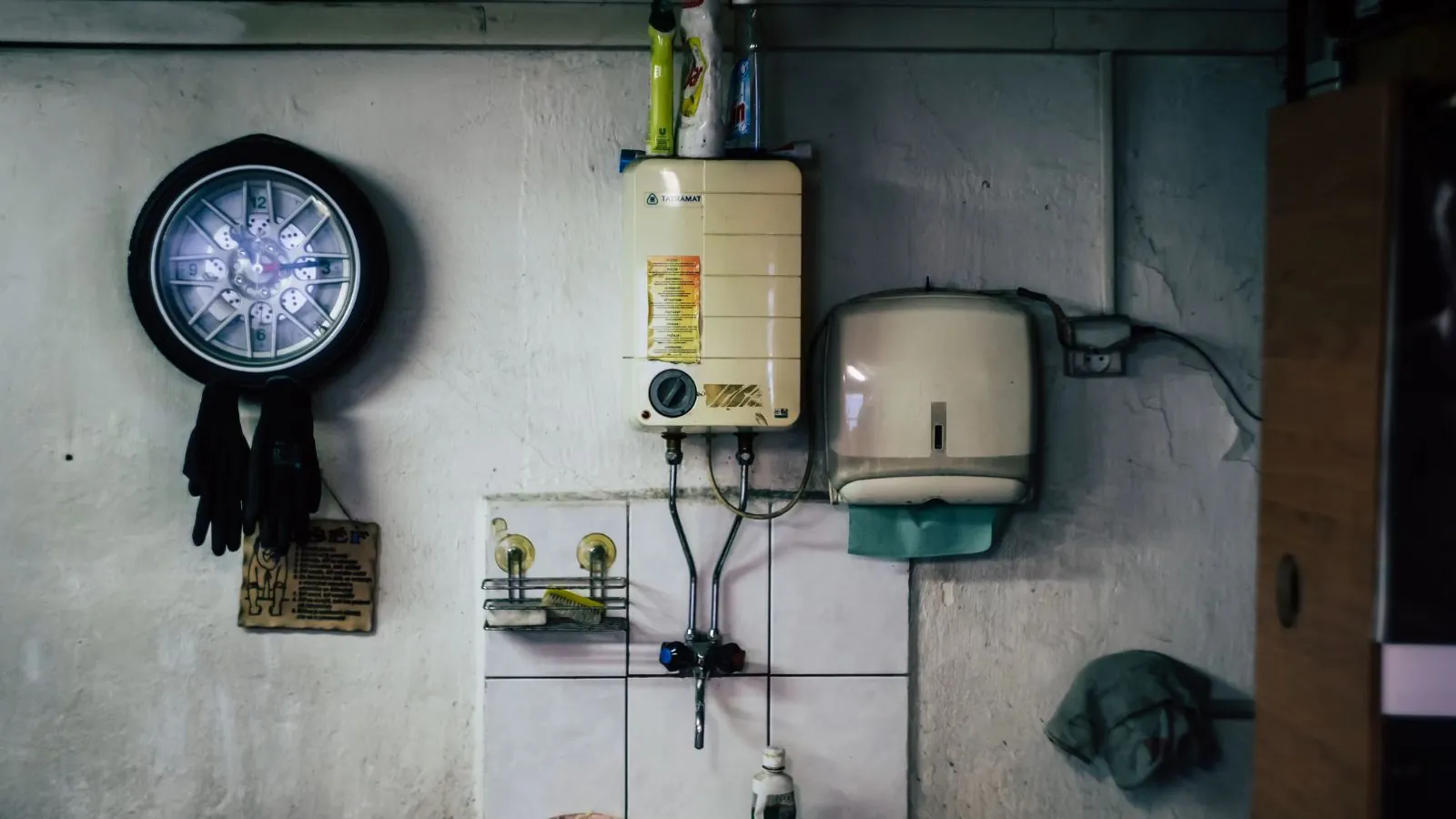
After a tank or its fittings leak, cleanup means pulling out the water and drying the floors and walls it reached. If yours is leaking now, call the 24/7 line. While you wait, close the cold water inlet on top of the tank, shut off the power or gas as shown below, and move boxes and stored items off the wet floor.
A tank holds a large volume, and a split seam lets it all out. A leak at a fitting or valve is slower but can still soak a utility room for days. Either way, the water has to be removed and the surrounding floor and walls dried.
Shutoff steps for gas and electric heaters
The water inlet is the same for both. The energy source is different.
| Step | Gas heater | Electric heater |
|---|---|---|
| 1. Water | Close the cold inlet valve on top | Close the cold inlet valve on top |
| 2. Energy | Turn the gas control to Off or Pilot | For an electric unit, flip the breaker only if the panel is dry |
| 3. Smell check | Gas odor: get everyone out, then call the utility or 911 | If you see sparks or wet wiring, leave and call the utility |
| 4. Drain | Attach a hose to the drain valve only after power or gas is off | Same, and do not touch the element while wet |
| 5. Relief | Open a hot tap upstairs to relieve pressure | Open a hot tap upstairs to relieve pressure |
A water heater is leaking right now
Quick actions that limit the loss before the crew arrives.
- Close the cold water inlet valve on top of the tank to stop new water entering.
- Turn off gas or power as the table above describes, and stay out if the floor is wet near outlets.
- Move boxes, tools and stored items off the floor of the utility room.
- Do not open the drain valve if the water is hot, because it can scald.
- Take photos of the tank, the label and the water line on the wall.
- Leave the heater in place so the plumber and the insurer can see the failure point.
Water still spreading? The 24/7 emergency line is open right now.
☎ Call (516) 845-9582Gas, power and hot water
A gas heater that smells of gas is an emergency. If gas is in the air, everyone goes outside and the first calls are to the utility and 911. Never stand in water to reach a panel. Water from the tank can be hot enough to scald, so keep children and pets away from the area.
Why tanks fail, and what hard water has to do with it
Tanks wear from the inside. Sediment settles at the bottom, scale builds on elements and the anode rod is consumed over time. The Port Washington Water District reported total hardness of 173 mg/L in its April 7, 2025 sample, and hard water is a known contributor to scale on tanks and fittings.
That does not mean every tank here will fail early. It does mean flushing the tank, checking the relief valve and exercising shutoff valves are worth doing. A tank that is old, rusted or wet at the base should be replaced before it fails.
What a slow leak looks like
A slow leak causes damage because no one notices it.
Rust streaks
Orange stains on the tank or the fittings point to a seep.
A damp drain pan
If the pan under the tank holds water, something is dripping.
A musty smell
A smell in the utility room often means moisture in the floor.
Warped baseboard
Swelling at the bottom of the wall near the heater shows wicking.
A rising water bill
If the water meter keeps turning while every fixture is off, a hidden leak is likely.
What gets wet around a water heater
Basement floors take the most water, and concrete dries slowly. Finished walls next to the heater wick water upward from the baseboard, and carpet or stored boxes soak it up. Drain pans catch small leaks, but a tank failure overflows them quickly.
Water extraction comes first, as covered on the extraction page, and the basement page explains finished and unfinished spaces. Affected walls are checked using the methods on the wall and drywall page.
Repair or replace the heater
That choice belongs to a licensed plumber. These are the honest trade-offs.
Replace the tank
A leaking tank body cannot be fixed. Replacement is the only option.
Replace a valve or fitting
Cheap if the tank is sound, but check the age before spending.
Add a drain pan and leak sensor
A pan with a drain line and a sensor limits the next leak.
Consider a tankless unit
Removes the stored volume, with a higher install cost and a different venting setup.
Cost factors for heater leak cleanup
Four or five things set the price. The water category is usually clean. The area covers the floor and any wall that wicked. Materials such as concrete, finished drywall and carpet dry differently. How long the leak ran sets the equipment and the drying days. Rebuild scope covers drywall and flooring replaced after drying.
The scope and price get explained first, before any gear is set up. Phone the 24/7 line and tell dispatch about the tank and which room it sits in.
Insurance and water heaters
Insurers often view a tank that ruptures at once as sudden and accidental damage, though the tank itself usually is not covered. A leak that went on for a long time may be excluded. Your policy wording decides, so read it and call the insurer.
Heater leaks near Port Washington
Heater failures happen at night as often as in the day. After-hours calls are taken, and a same-day visit depends on crew availability. Calls from Old Westbury are taken the same way, and the village has its own building department, so ask it about plumbing permits.
If the leak runs under a wall, see the burst pipe page for supply line failures.
Frequently asked questions
Do you handle water heater leak emergencies at night or on weekends in Port Washington?
Yes. Dispatch is staffed day and night, with same-day response depending on crew availability. Close the cold inlet and turn off power or gas before you call.
How do I shut off a leaking water heater?
Close the cold inlet valve on top. For gas, set the control to Off. For an electric heater, go to the breaker only when the floor around the panel is dry.
Can a leaking water heater be repaired?
A leaking tank cannot. A leaking valve or fitting can, if the tank is sound.
Is my water heater leak covered by insurance?
The resulting damage may be, but the tank usually is not. Ask your insurer.
Does hard water cause water heater leaks?
Hard water is a known contributor to scale, which can shorten the life of a tank. It is not the only cause.
Should I drain the tank myself?
Not if the water is hot or the floor is wet near power. Wait for a plumber.
Ready to talk it through? Call the 24/7 line.
☎ Call (516) 845-9582