
A moisture meter shows a number, and on its own that number tells you very little. Water damage moisture readings are measurements of how much moisture a material holds, taken with a meter and judged against a dry reference reading from similar unaffected material in the same building. A reading is high or low only compared with that baseline.
This matters because drying is not finished when a surface feels dry. Framing, subfloors and the back of drywall can hold water long after the paint looks fine. Below, you will see how readings are taken, why wood and drywall give different numbers, where thermal imaging helps and where it misleads, and why daily logs matter.
Start with a dry reference
The method is simple, and it is the reason two technicians with different meters can agree on the same wall.
Find unaffected material of the same type
Pick drywall in a dry room for drywall readings, framing for framing, and the same flooring species for flooring. Different materials cannot be compared with each other.
Take the reference reading
Record it and note the room conditions. This is your dry standard for that material in that building.
Map the affected area
Take readings across the wet zone and out past the visible edge until values match the reference. The edge of the wet zone is often farther than the stain.
Mark and number the points
Use the same spots every day. Marking them on the wall or a sketch lets a different person repeat the check.
Compare, then repeat
Each day, compare readings with the reference and with the day before. Falling values mean drying is working, and flat values mean something needs to change.
Why readings differ by material
No single number means dry for everything. These notes are about behavior, not targets, and no figure here applies to every job.
| Material | How it behaves | What the reading tells you |
|---|---|---|
| Drywall | Absorbs quickly and often reads high near the floor | Whether moisture is still wicking up the wall |
| Wood framing | Holds water slowly and releases it slowly | Whether studs and plates are back near their dry baseline |
| Hardwood flooring | Swells, cups and moves as it dries | Whether the boards have settled toward a stable reading |
| Concrete slab | Dense and slow, so moisture may move up from below | Whether vapor is still coming through the surface |
| Carpet pad and insulation | Soaks up water and traps it | Often replaced, so readings guide removal rather than drying |
Questions about your situation? Call the 24/7 line and describe what you see.
☎ Call (516) 845-9582Pin meters, pinless meters and what they miss
A pin meter pushes two probes into a material and measures resistance, so it reads at a specific depth. A pinless meter scans a broader area without damage but averages what it sees. Both give a relative reading, and a good technician uses each where it fits.
Both can be thrown off by metal behind the wall, foil-faced insulation, dense finishes and uneven surfaces. When two readings disagree, trust the pattern across several points more than any single number.
Thermal imaging has limits
A thermal imaging camera shows surface temperature differences. Wet areas can look cooler because water evaporates, and that makes the camera helpful for finding where to check first. It does not measure moisture, and it cannot see inside a wall.
Sunlight, a cold exterior wall, plumbing lines and air leaks can all cause the same cool patch. Use the camera to point at a spot, then confirm with the meter.
What a good daily log includes
A drying log is a record, so it should be specific enough for someone else to rebuild the picture.
- The date and time of each visit.
- The dry reference reading for each material type.
- Readings at the same numbered points as the previous day.
- Indoor temperature and relative humidity.
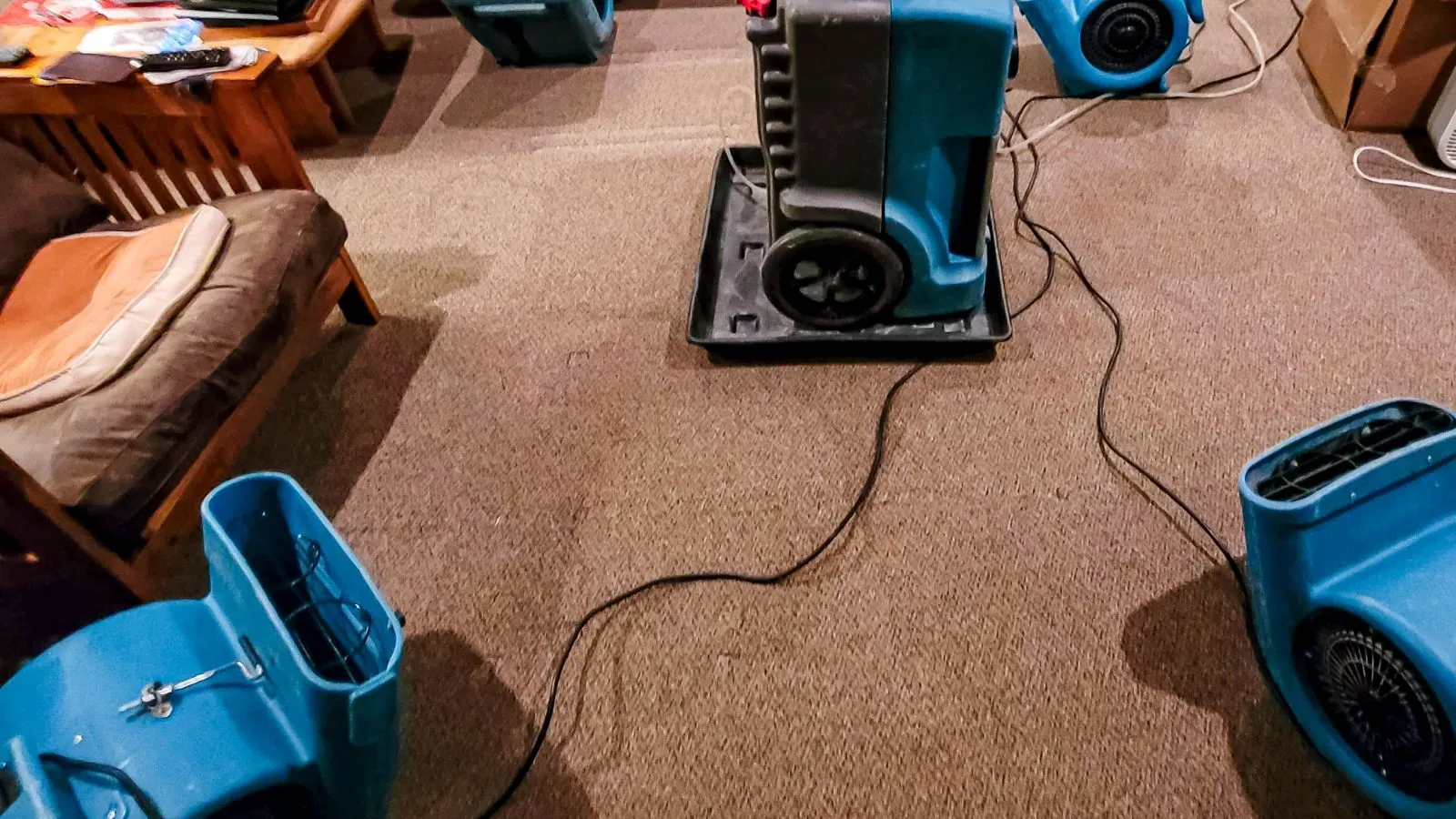
- The number and placement of air movers and LGR dehumidifiers.
- Notes on any materials removed and why.
Reading the trend, not the day
One high reading is a snapshot. Four days of falling readings that level out near the reference tell a story. If a point stops falling while others keep dropping, the cause is usually trapped moisture behind a finish, a cavity that needs opening or equipment placement that needs adjusting.
This is why daily logs matter more than any single reading. They show when structural drying and dehumidification has done its work and when something has been missed.
Wet wall cavities
Drywall can look fine from the room while the back face and the bottom plate are still wet. Readings at several heights tell you whether the wet zone stops at the baseboard or climbs. If values stay high after drying, a small opening may be needed, which is how wall and drywall repair often begins.
Do not trust a single reading
A reading from one spot on one day, on a material you have no baseline for, is not proof of anything. Ask for the dry reference and the log.
What this means in Port Washington
Once readings show a wall or floor must be opened and rebuilt, permits come up. Unincorporated Port Washington applies through the Town of North Hempstead on its MyToNH portal, while a village address deals with its own hall, so confirm which applies before the dry-down ends and keep the final readings with the permit file.
Dated moisture logs help in both places. They show that structure was dry before it was closed up, which supports permit paperwork and an insurance file. Homeowners in nearby Roslyn Heights and Greenvale sit in the same Town, so the same record-keeping habit applies.
Frequently asked questions
What is a normal moisture reading for drywall?
There is no single number that applies to every building. Readings are judged against a dry reference taken from unaffected drywall in the same home, and the scale depends on the meter.
Can a thermal camera tell me if a wall is wet?
It can show a cool patch that suggests where to look. It does not measure moisture, so the area still needs a meter reading to confirm.
How many days of readings are normal?
It depends on the material, the amount of water and the equipment. Daily logs show whether values are falling, and the trend decides when drying is finished.
Can mold start if readings stay high?
Mold needs moisture, so materials that stay wet are a concern. Mold questions go through the state's Department of Labor process, and health questions go to a physician.
Who might ask to see drying records for a Port Washington home?
Your insurer is the most likely. If the rebuild needs a permit, the permit office depends on whether your address is in the unincorporated area or inside a village.
Do I need to ask for the log?
Yes. Ask whether the company keeps dated readings at marked points, and request a copy for your own file.
Ready to talk it through? Call the 24/7 line.
☎ Call (516) 845-9582